Years ago, we created a gin pole set-up. I copied a set-up that I saw in a book written by Richard Babcock, and Jack Sobon helped me, with advice, as well.

This type of gin pole is basically and upside down T with braces. This makes the gin pole very stable as it can only pivot back and forth, and can't lean very much if any left and right.
When we use it on a frame raising we usually tie off the back line and two side guide lines to the sills of the frame. This makes it easy as we don't have to chase around for anchors.
Somewhere I read or heard that you shouldn't lean the gin pole over more then 20° from upright.
In the above picture we were testing the system, ropes, blocks, lines and everything, by leaning it more and overloading it trying to push it to twice the load that we were intending to lift at the raising. We did this to test and make sure the entire system was safe.
It didn't fail and we used it and it was great.
Also, we created a wooden winch for pulling in the line. This winch we have called a windlass, but I believe that windlass winches have horizontal axles and that a vertical axle winch is called a capstan. But with the gin pole and our windlass we could lift 500 lbs of timbers with just 10 lbs of pressure on the windlass handles.
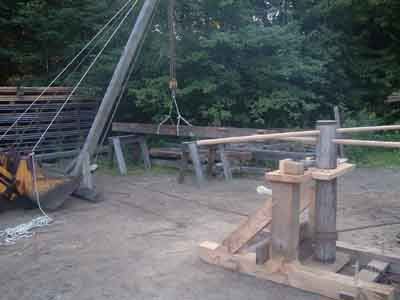
This windlass needs some improvement in the drum as the body of the drum is not hour glass shaped and because of this the line doesn't properly slide to self center. And because it doesn't self center it walks either up or down the drum, depending on how we feed it onto the drum.
It was fun to use and easy once you have it all set up.
Although we didn't use a front line to the gin pole I highly recommend that anyone who does create a gin pole uses a front line, that Jack Sobon called a safety line as it prevents the gin pole from accidentally falling over backwards when the load is at the top and the center of gravity is very high.
Hope that helps
Jim Rogers


