|
|
Joined: Nov 2003
Posts: 1,124
Member
|
|
Member
Joined: Nov 2003
Posts: 1,124 |
I would suggest that an axe with a chip out of it leaves a crappy signature, like a bad pen.
instead of seeing the quality of the axework, you see the scratches left by the chip.
I had a 12 inch north american style broadaxe, I cut it down to a 9 inch and it's still to heavy for me compared to my Austrian goosewing... what a wimp!
I would not try to restore a broadaxe or any tool with rust pitting on the back, or flat side of the blade. Some pitting on the bevel side is not a big deal.
|
|
|
|
|
Joined: May 2007
Posts: 167
Member
|
|
Member
Joined: May 2007
Posts: 167 |
that;s cool- i think a lot of axemen started by changing the blade with a file. modification- to relieve the front corner to give it a bit of finesse up front. just to tease the wood.
Mark- maybe the axe was a foot level kind? and you are a beast. the old CN axes up here are the 12 inch big ones and i'm guessing intended to be used differently than the Penn-syl-vanians did. my sense these are more chopping-type axes.
bang on that the flat side of the axe needs to be flat
|
|
|
|
|
Joined: Dec 2007
Posts: 1,882
Member
|
|
Member
Joined: Dec 2007
Posts: 1,882 |
It's not that I would choose to place a nick in the blade of my axe, but after a bad fall from timber to concrete my beloved slick was used for some time with a nick in the blade, we worked it out eventually. There was an old church here in Machiasport that was taken down, the timber was hewn and on a number of the members you could see that the same axe was used on these timbers, the hewing was fine, the nicks, there were two side by side, did not destroy the work. I have ever since called them railroad tracks. I found appreciation and sympathy in those track.
The nick in Jim's axe is a rather large nick verging on a chunk. Does anyone have an opinion of the quality of the steel that would yield such a nick? I tend to favor a softer steel, one that a file will cut. I have seen a number of draw knives that are so hard they will dull a file and they are only sharpenable with a stone. All my tools must pass the file test.
Tim
|
|
|
|
|
Joined: Sep 2007
Posts: 11
Member
|
|
Member
Joined: Sep 2007
Posts: 11 |
I would not try to restore a broadaxe or any tool with rust pitting on the back, or flat side of the blade. Some pitting on the bevel side is not a big deal.
I feel obligated to interject here. I don't claim to be anywhere near Mark's level of Timberframer, not even close. However, as a hobby TF'r I think there are a lot of great tools out there which can be bought relatively cheaply, though they may not be up to the standards required by a professional tradesman. I've got a couple nice Witherbys which had some pitting on the non-bevel side and they serve me well for my level of TF'ing. Sure, they needed some work when they arrived, but for beginners such as myself they're great additions to my kit. I just wouldn't want a budding TF'r to think that anything with some rust on it is junk and that he/she has to buy all their tools from Barr (even though they are amazing).
|
|
|
|
|
Joined: Jul 2008
Posts: 191
Member
|
|
Member
Joined: Jul 2008
Posts: 191 |
I'd tend to agree with Mark. A tool pitted on the flat,, anywhere close to where the edges might meet after several sharpenings is going to be hard to give a nice edge on.
It really depends on the individual item. I see dozens of examples at ontario antique shows each year,, and haven't brought one home yet. They tend to be so pitted,, it wouldn't be worth the energy. Even with time on your hands. my 2 cents!
|
|
|
|
|
Joined: Dec 2007
Posts: 1,882
Member
|
|
Member
Joined: Dec 2007
Posts: 1,882 |
I am now working on a axe recently brought back from France. It weighs in at 3 pounds with a 14" blade, a type of T-axe, it is very thin and has rust pits on the nearly flat back. It can receive a handle from either end of the eye. I have cleaned it up with a stone enough to test the steal, I am satisfied enough to proceed and take it on with a belt sander to bring the back clean once more. This head not only was pitted but it had flakes wanting to come off. If this cleans up I feel it will be well worth the effort applied.
Tim
|
|
|
|
|
Joined: Nov 2003
Posts: 687
Member
|
|
Member
Joined: Nov 2003
Posts: 687 |
Tim, may I trouble you for a photo of the T Axe?
|
|
|
|
|
Joined: Dec 2007
Posts: 1,882
Member
|
|
Member
Joined: Dec 2007
Posts: 1,882 |
I will have some this evening.
Tim
|
|
|
|
|
Joined: Mar 2002
Posts: 1,696
Member
|
|
Member
Joined: Mar 2002
Posts: 1,696 |
 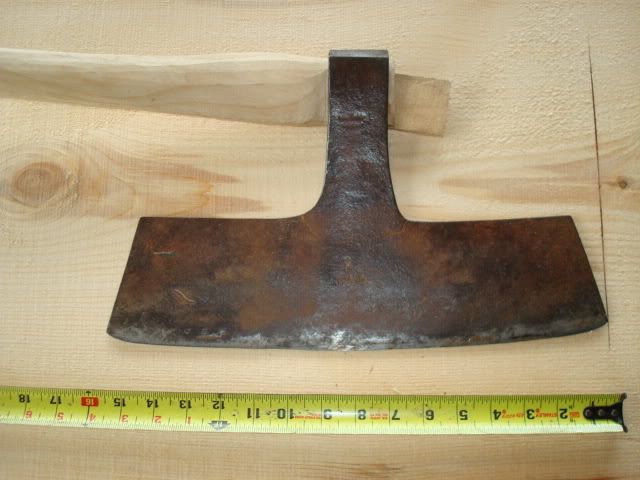 reposting Tim's images......
Last edited by Jim Rogers; 07/03/09 12:57 PM. Reason: to explain why
Whatever you do, have fun doing it!
|
|
|
|
|


