There are some standard rules for scarf locations and sizes.
One that is important, at least to me, is the amount each timber overlaps the other timber it is joining. I used to use 3 times the depth of the timber. But a while ago, I asked Jack Sobon what he uses for a standard. And he said he uses 4 times the depth.
So if your timbers are 12" deep then you need a four foot scarf.
The next standard rule is the location of the scarf.
This picture below is a graph of the stresses on a plate when supported by several posts.
To read this graph you look at the line labeled "Shear". Here you will see that the shear is highest right over a post. This is the reason you don't want to have your scarf over a post. This is where the highest shear point is and you have cut your nice 12" deep beam in half.
Next look at the line labeled "moment" this is where the most load will be pressing down on the plate. It is in the middle between the supports. You don't want your scarf here as you have cut your nice 12" deep beam in half again.
You want to make your scarf someplace where there is a balance between these to force/stress points.
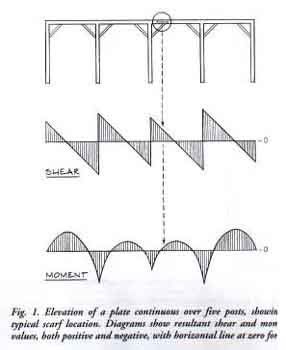
The reason for setting the scarf joint just off the post is that is will receive less stress there.
Look at this drawing:
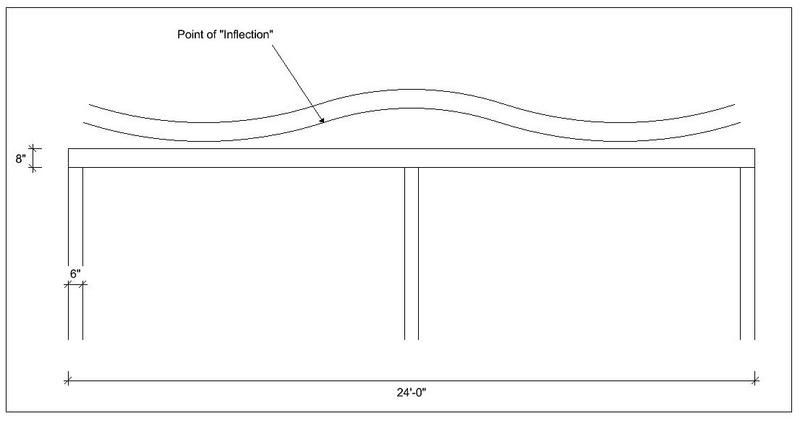
Between the posts the unsupported timber will sag or deflect. Over the center post the timber will crown.
This causes this "exaggerated" wave shape effect in the timber.
At the point where the sag or deflection changes to a crown is called the point of "inflection".
This point is where the timber is neither sagging nor crowning. It has the least amount of both forces.
This, I am told, is where the joint should be made. If I understand all this correctly.
I hope this helps to explain why joints shouldn't be made over posts or directly between the posts.
Jim Rogers


