|
|
|
|
Joined: Dec 2005
Posts: 75
Member
|
|
Member
Joined: Dec 2005
Posts: 75 |
I worked with Will on the sawmill job. Jim at Rondout Woodworking and his very sharp crew experimented a fair bit with which teeth to bend, how many, and the feed rate before coming up with a very convincing pattern. Obviously, it would take some trial and error depending on the specifics of the sawmill blade, the blade speed and feed mechanism as well as the species/hardness of the material. I'm sure with some patience and perhaps a few blades to work with, you can nail it. Good luck!
|
|
|
|
|
Joined: Feb 2006
Posts: 718
Member
|
|
Member
Joined: Feb 2006
Posts: 718 |
I hit a nail sawing out some hickory this afternoon and it left a finish very similiar to up/down sawmill. Now if I could only tell which teeth got bent. I couldn't see any visual damage, so I would probably have to put it on the setter and use the dial indicator to pick out the bent teeth. I am guessing it's probably all trial and error.
Dave
Member, Timber Framers Guild
|
|
|
|
|
Joined: Feb 2006
Posts: 332
Member
|
|
Member
Joined: Feb 2006
Posts: 332 |
The closer you look the more you see.
"Heavy timber framing is not a lost art" Fred Hodgson, 1909
|
|
|
|
|
Joined: Sep 2004
Posts: 37
Member
|
|
Member
Joined: Sep 2004
Posts: 37 |
I have a manual bandsaw mill and it is actually quite easy to replicate the look of U&D sawn on manual mills. I too discovered it after throwing a blade off which resulted in 3 bent teeth. Since then I have actually tried to replicate this rough sawn look for a couple projects and it looks quite convincing.
The best way I found was to saw the timber with a good blade so the cut is straight smooth and sqaure and of the desired dimension. Then remove the timber and the good blade. Install an old blade and overset a couple teeth on the downward side of the band. Put a slab of scrap lumber on the saw and lower the blade until it bearely touches the surface of the wood. Drag the saw backward (careful not to knock the band off doing this) for a fuzzy textured cut. Pushing it forward makes a cleaner defined groove cut but it may have a tendency to dig in if you aren't careful . Make a few practice runs. The lower the saw blade the deeper the grooves, the more hooked the tooth is the narrower the groove. Once you've got the hang of it put on the timber.
For some other interesting effects the log can be dogged at a slight angle on the bed for one pass to replicate a pit sawn look. Making a second pass at the opposite angle creates a cross hatch pattern sometimes seen in hand sawn lumber or in that sawn on really large circular mills where curve is not discernable and the blade dragged a little exiting the timber.
As for patina, it depends what color you are looking for. A photo of what you are trying to reproduce would be very helpful. Black and grey colors can be had with water, chemicals and metals. Browns and reds come with oils and UV exposure. Wear marks or a few rusty bent nails can lend a lot of credibility to making timber look old too.
|
|
|
|
|
Joined: May 2004
Posts: 286
Member
|
|
Member
Joined: May 2004
Posts: 286 |
I did a little playing with the mill and a fresh (and frozen) Hickory log yesterday. I sharpened the chain with a little slop in the top angle and am wondering how this compares to the look we are discussing? 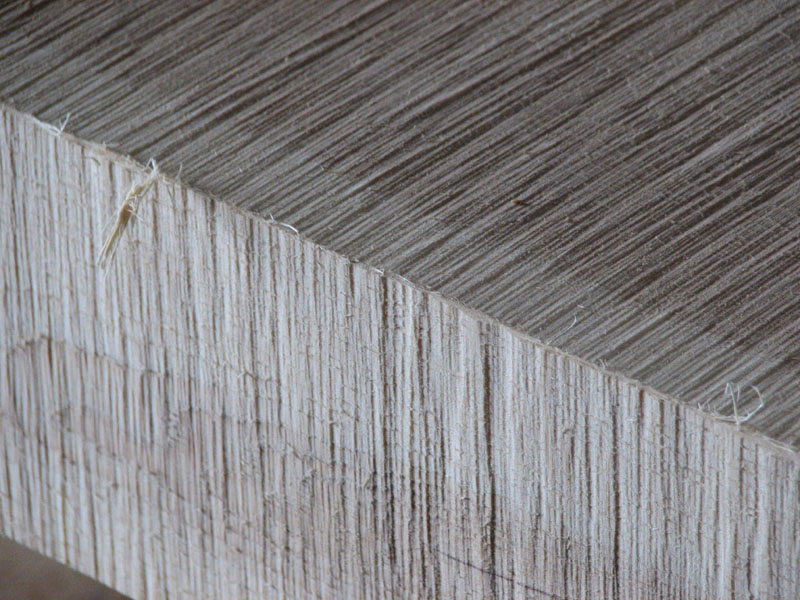
Raphael D. Swift
DBA: DreamScapes
|
|
|
|
|
Joined: Jan 2007
Posts: 4
Member
|
|
Member
Joined: Jan 2007
Posts: 4 |
Housewright,
I am puzzled why you are looking to duplicate the look when there's a large quantity of recyled beams available. A google search under recycled wood, barn wood, barn beams, antique wood or vintage wood will provide you with lots of possibilities. I know that hand hewn is more common but sawed beams and timbers are available.
Mike
Mike
|
|
|
|
|
Joined: Feb 2006
Posts: 332
Member
|
|
Member
Joined: Feb 2006
Posts: 332 |
Thanks Again Everyone;
NSMike;
I am unsuccessfully looking for 8x10x16' vertically sawn oak antique timbers. Thr 24' pole rafters are proving hard to find, too.
Jim
The closer you look the more you see.
"Heavy timber framing is not a lost art" Fred Hodgson, 1909
|
|
|
|
|
|
|