Previous Thread
Next Thread
Print Thread
Rate Thread
Page 4 of 5 1 2 3 4 5
Joined: Apr 2009
Posts: 235
Member
Member
Joined: Apr 2009
Posts: 235
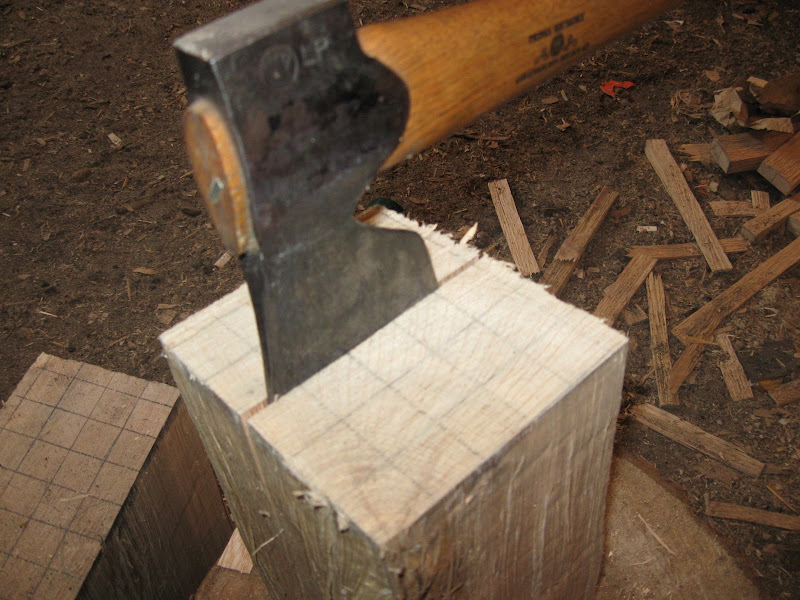
Ok, peg making 101
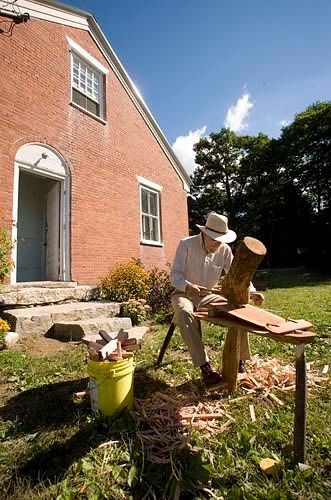
Since I don't have a Froe, I make do with my Axe.

Here is my Shaving Horse adaption to my work bench.
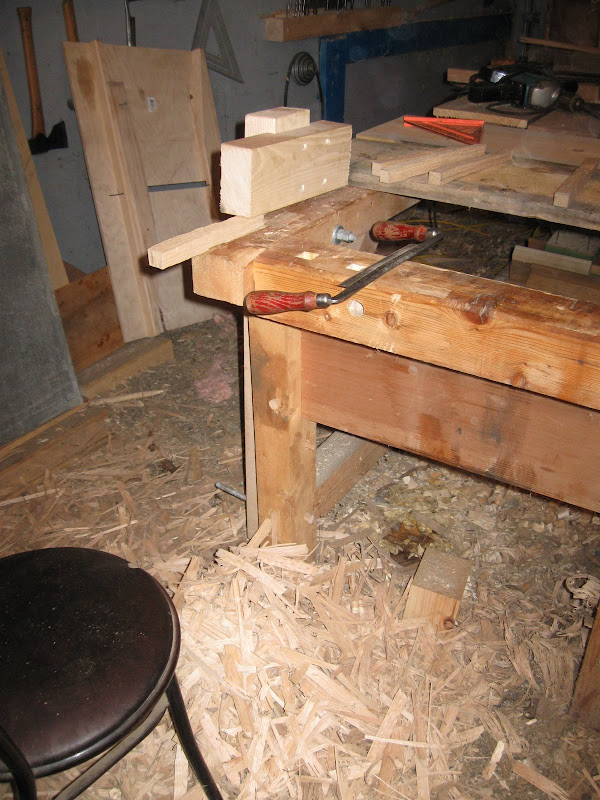


Once split it needs to be squared to size.
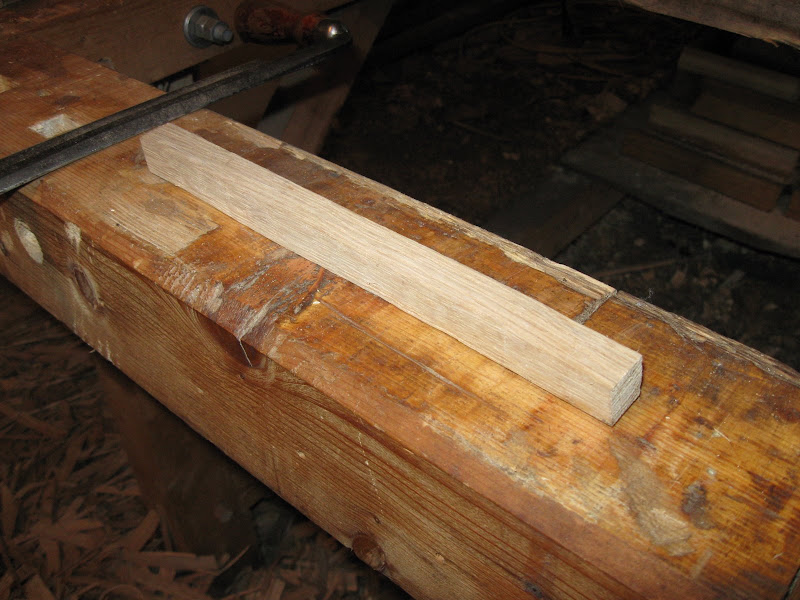

After squaring remove the corners to produce an octagon.
A taper may be introduced at any point in the process.

After I'm finished making a tapered octagon peg, which may be slightly over-size across the flats, I will them drive it through a hardened steel Die which has been inlet into the front beam on my work bench.
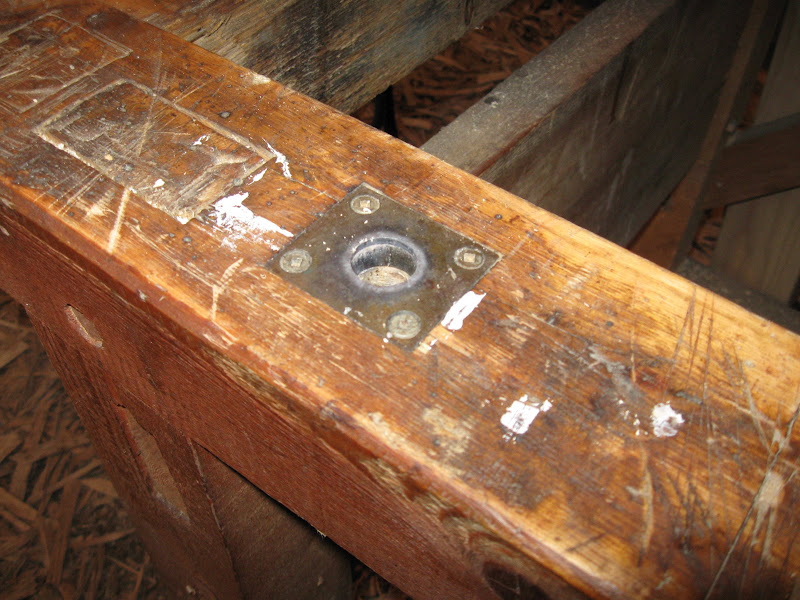

Here the Die has engaged the peg.
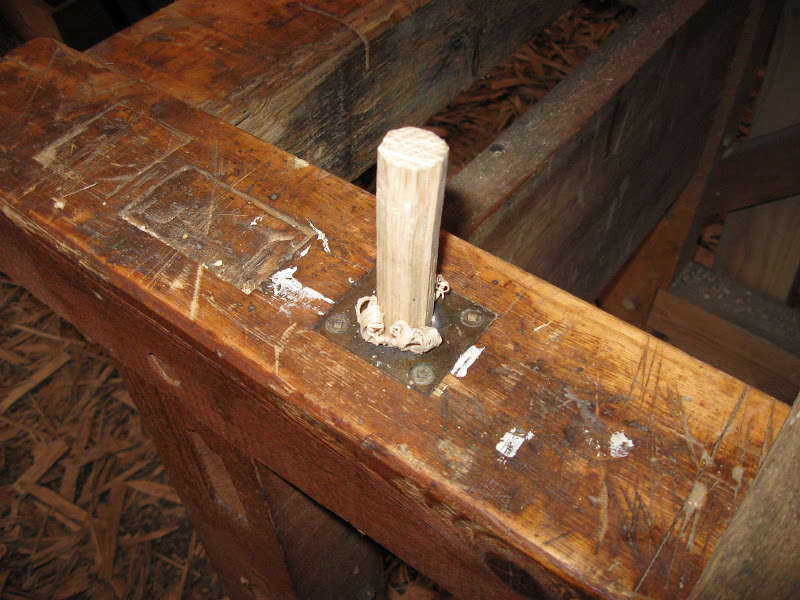

I was a bit close for this next photo but you can see how the Die works.
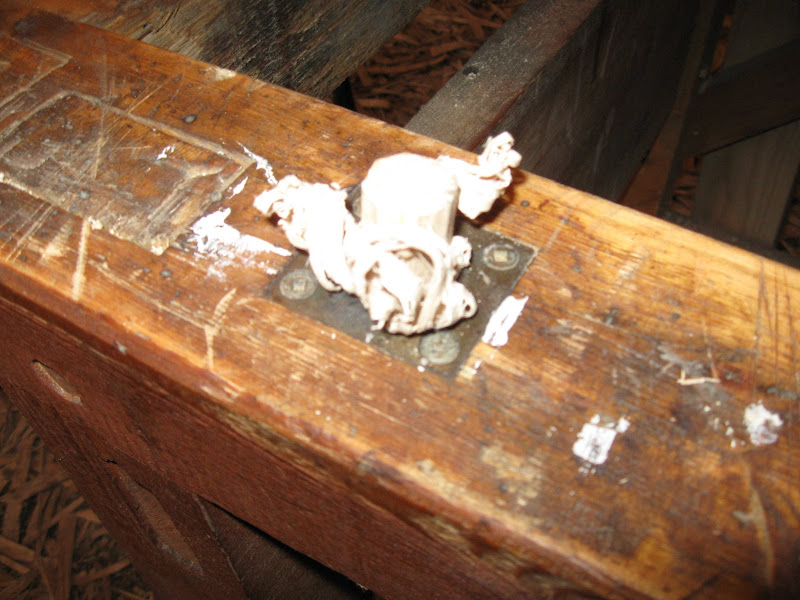

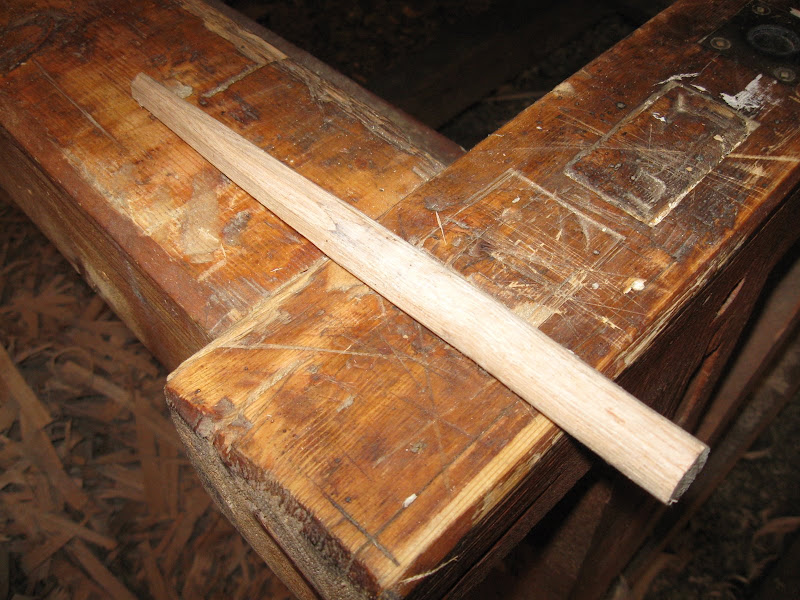
The finished round peg with Octagon tapered end.
The process (not including the splitting part) takes about 2 to 3 minutes each.




Life is short so put your heart into something that will last a long time.
Joined: Aug 2006
Posts: 242
T
Member
Member
T Offline
Joined: Aug 2006
Posts: 242
What are you using for the pivot(spindle) material that the dumbhead or crossbar is pivoting on? Is it metal rod or wooden? I like that it does not have legs, as it stores well and easily can be put on top of a couple of horses or ponies when in use. I will build one, almost immediately, I just need to figure a few more details. What thickness do you recommend in the bench and ramp, and frame material. It looks like 2" oak? tb

Joined: Apr 2009
Posts: 235
Member
Member
Joined: Apr 2009
Posts: 235
It's a 1/2" bolt with a washer between the leg and beam.
Snug and double nut.
Both the leg and head are appx. 2.5 x 4" Ash with the head half-lapped onto the leg. Oak will work as well. There is also a bolt sticking out of the bottom of the leg to act as a foot peddle. There is a small v-groove in the beam to which the head presses against to hold the square pc. on a 45 deg. while it is also able to straddle the groove when squaring.


Life is short so put your heart into something that will last a long time.
Joined: Feb 2006
Posts: 332
H
Member
Member
H Offline
Joined: Feb 2006
Posts: 332
Brad;

I think 12.5 inces is plenty. I have not split enough wood to be able to tell if it is straight, clear grain before starting to split. Trial and error, which means you need to acquire more wood than you think you need to account for imperfections.

Jim


The closer you look the more you see.
"Heavy timber framing is not a lost art" Fred Hodgson, 1909
Joined: May 2002
Posts: 447
Member
Member
Joined: May 2002
Posts: 447

Brad – 12 ½” is doable, but the longer the better. Wide enough to fully cross a billet being ideal, but the shape is maybe more important than the length.

Here's a maybe, it is described as fully tapered, though they lose me with the “razor sharp” line. Froes do not need to be sharp in the common sense. I 've not seen one, but they might be worth asking after - http://www.traditionalwoodworker.com/product_info.php/cPath/36_387/products_id/4949

This is a shot of my current horse, Pegasus IV – Taking the Drawshave to Locust for the upend of the Windbracing on the recently wrapped bridge project.- http://twitpic.com/mhfpg


"We build too many walls and not enough bridges" - Isaac Newton

http://bridgewright.wordpress.com/

Joined: Nov 2005
Posts: 305
T
Member
Member
T Offline
Joined: Nov 2005
Posts: 305
I got a sweet froe off ebay. Here's another potential source:
http://countryworkshops.org/Store.html

My horse is definitely of the dumbhead type. Someday I hope to carve an actual dumb-looking head, maybe something ala Marge Simpson.


Joined: Aug 2006
Posts: 242
T
Member
Member
T Offline
Joined: Aug 2006
Posts: 242
I am tending towards the treadle frame like the one Will is using. Will, does the yoke stay in a fixed position or is it allowed to rotate? tb

Joined: May 2002
Posts: 447
Member
Member
Joined: May 2002
Posts: 447

TB - I'm unsure what you are calling the yoke??? or what you are asking is rotational ?

The only moving part is the Head, it consists of the two verticals, the treadle, the axle, and what I always called the clamp...

I don't tend to bother with plans for small projects so had never looked for any - So I googled around just now looking for a common nomenclature (I'd been releying on memory of a copy of Woodwrights Shop I haven't opened in ten years - Which doesn't completely apply in that Roy only speaks to the dumbhead pattern common to the Southeast) And found this page - http://www.greenwoodworking.com/ShavingHorsePlans - Good stuff there

And they call the clamping piece a Yoke - If puts us in the same place, then no, the one pictured is fixed.


"We build too many walls and not enough bridges" - Isaac Newton

http://bridgewright.wordpress.com/

Joined: Jan 2007
Posts: 603
Member
Member
Joined: Jan 2007
Posts: 603
Thane, I'd call that die "Quality Control". Just curious, what diameter does it produce, and how does that compare to the hole you drill? It's too hard to see in the picture, but is the die just a regular hole with sharp edges?

Joined: Apr 2009
Posts: 235
Member
Member
Joined: Apr 2009
Posts: 235
Brad
The peg that comes out is the same size as the die and the pegs fit snug into the holes drilled in the timbers. Quality control? Sure, why not.
The die is a hole drilled through a steel plate with sharp edges and heat treated.


Life is short so put your heart into something that will last a long time.
Page 4 of 5 1 2 3 4 5

Moderated by  Jim Rogers, mdfinc 

Link Copied to Clipboard
Powered by UBB.threads™ PHP Forum Software 8.0.1
(Release build 20251126)
Responsive Width:

PHP: 8.3.35 Page Time: 0.235s Queries: 36 (0.211s) Memory: 3.0406 MB (Peak: 3.5655 MB) Data Comp: Off Server Time: 2026-10-11 08:55:09 UTC
Valid HTML 5 and Valid CSS